Eye shape is the primary determinant for selecting lash lift styles, curl types, and the tools a technician uses to achieve a flattering, lasting result. The role of eye shape in lash lift customization goes far beyond aesthetics. It dictates rod versus shield selection, curl strength, and lash mapping strategy. Almond, round, hooded, monolid, protruding, and deep-set eyes each respond differently to the same treatment. Without accounting for eye anatomy, lash direction, and lid space, even a technically correct lift can look wrong on the face. Browvibe’s certified artists treat eye shape assessment as the foundation of every lash lift consultation, not an afterthought.
How eye shape influences lash lift techniques and results
The impact of eye shape on lashes is the single most important variable a lash technician evaluates before selecting any tool or curl. Different anatomies create different visual problems and opportunities, and the lift must address both.
Almond eyes are the most versatile shape for lash lifts. The naturally balanced lid proportions allow for a wide range of curl types, from a soft C-curl for daytime wear to a dramatic D-curl for a more open, defined look. Almond eyes rarely require corrective mapping, so the focus shifts entirely to the client’s preferred aesthetic.
Round eyes present a specific challenge. A strong D-curl on a round eye creates a startled, wide-open expression that reads as unnatural. The best approach for round eyes is a softer C-curl combined with elongated outer-corner lashes, which draws the eye horizontally and softens the circular silhouette.
Hooded and monolid eyes share a common problem: the lash line sits partially or fully beneath the lid fold, hiding the lift. These shapes need stronger lifts, specifically a D-curl or L-curl, to push lashes above the fold and create visible definition. Stronger lifts for visibility are not optional for hooded eyes. They are the only way the treatment registers at all.
Protruding eyes benefit from a softer curl that does not amplify the forward projection of the eye. A C-curl or CC-curl keeps lashes lifted without drawing more attention to the eye’s prominence. Deep-set eyes face the opposite problem: the brow bone sits close to the lash line, and an aggressive curl can cause lashes to press against the bone, creating discomfort and a flattened look.
- Almond: C to D-curl, flexible mapping, most style options available
- Round: C-curl with elongated outer corners, avoid D-curl
- Hooded/Monolid: D-curl or L-curl, strong vertical lift required
- Protruding: C or CC-curl, soft lift to reduce eye prominence
- Deep-set: moderate curl with rod selection to push lashes forward
Pro Tip: Ask your technician to assess your natural lash direction before choosing a curl. Lashes that grow downward need a different starting point than lashes that already grow forward.
Rods vs. shields: which tool matches your eye shape?
The technical distinction between rods and shields is one of the most misunderstood aspects of lash lift suitability by eye shape. Both tools lift lashes, but they produce structurally different results, and the wrong choice creates problems that no amount of curl solution can fix.
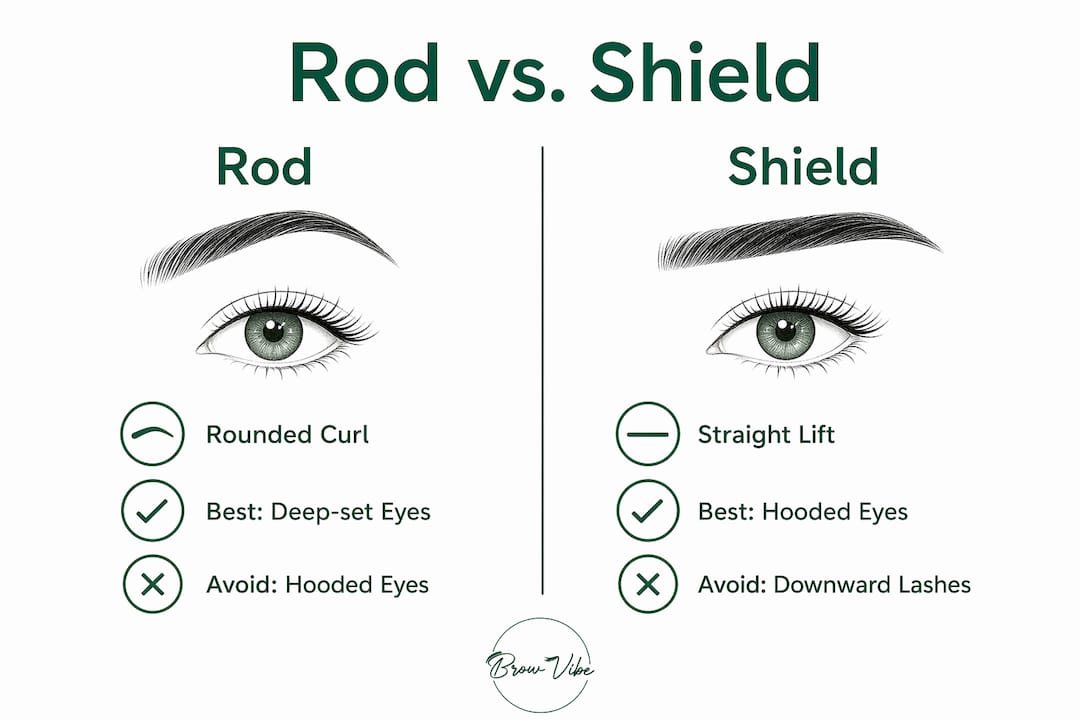
Rods create a rounded, C-shaped curl. Their curved surface pushes the lash base forward before curling it upward, which is critical for eyes where the brow bone sits close to the lash line. Rods push lashes forward before the upward curl begins, creating clearance between the lifted lash and the brow bone. This makes rods the preferred tool for deep-set eyes and for clients with naturally downward-growing lashes.
Shields create a flat, vertical lift. The lash adheres to a flat surface, which produces a straighter, more dramatic upward extension rather than a rounded curl. Shields create vertical lift suited to monolid and flat lash beds where a rounded curl would collapse back against the lid. For protruding eyes, shields can also reduce the exaggerated curl effect that rods sometimes produce.
| Tool | Curl shape | Best eye shapes | Avoid for |
|---|---|---|---|
| Rod | Rounded, C-shaped | Deep-set, downward lashes, almond | Monolid, flat lash beds |
| Shield | Flat, vertical | Monolid, protruding, flat-growing lashes | Deep-set, prominent brow bone |
| Hybrid shield | Moderate curve | Hooded, combination anatomy | Extreme downward lash direction |
The same shield produces different results on two clients with different lid space and lash direction. This is why industry professionals reject one-size-fits-all tool selection in favor of a technical assessment before every appointment. Lid space, brow bone prominence, and natural lash angle all feed into the decision.
Pro Tip: If a previous lash lift left your lashes pressing flat against your lid or curling into your brow bone, the technician likely used the wrong tool for your eye anatomy. A lash lift gone wrong is almost always a tool or curl mismatch, not a product failure.
How lash mapping and curl types adapt to eye shape
Lash mapping is the practice of assigning specific curl types and lengths to different zones of the lash line to correct, balance, or enhance eye shape. It is where the role of eye shape in lash lift planning becomes most precise. A flat lift applied uniformly across the lash line ignores the fact that the inner corner, center, and outer corner of the eye serve different visual functions.
The primary curl types used in lash lifts are:
- C-curl: Natural, soft lift. Best for almond and protruding eyes.
- CC-curl: Moderate lift with more visible curl. Works for most eye shapes as a balanced option.
- D-curl: Strong, dramatic lift. Preferred for hooded, monolid, and deep-set eyes.
- L-curl: Flat base with a sharp upward bend. Designed specifically for downward-growing or straight lashes on monolid and hooded eyes.
- M-curl: Similar to L but with a slightly softer bend. Used when L-curl produces too sharp a result.
Lash mapping strategies prevent over-processing and align the lift with the client’s natural anatomy. For downturned eyes, heavier length on the outer corners drags the eye further down, so mapping keeps outer lashes shorter and concentrates volume toward the center. For close-set eyes, shorter inner-corner lashes create the visual illusion of more spacing between the eyes.
Three mapping styles dominate professional practice in 2026:
| Mapping style | Visual effect | Best eye shapes |
|---|---|---|
| Cat-eye | Elongated outer corners, lifted tail | Almond, downturned, round |
| Doll-eye | Maximum center volume and lift | Deep-set, small eyes, monolid |
| Squirrel mapping | Peak lift at outer two-thirds | Hooded, protruding, almond |
Mixed curl sets produce more natural depth and dimension than a single curl applied uniformly. A skilled technician might use a CC-curl at the inner corner, a D-curl at the center, and a C-curl at the outer edge to create a graduated effect that mimics natural lash variation. This approach is particularly effective for hooded eyes, where a flat uniform lift often looks artificial.
Practical tips for choosing and maintaining the right lash lift
Tailoring a lash lift to your eye shape starts before you sit in the chair. The consultation is where the most important decisions get made, and arriving prepared makes a measurable difference in the outcome.
- Request a full eye shape assessment. A qualified technician should evaluate your lid space, brow bone proximity, natural lash direction, and lash length before recommending any curl or tool. Consultation questions that address these factors separate a professional service from a generic one.
- Ask specifically about curl type, not just lift strength. Many clients leave consultations knowing they want a “strong lift” but not knowing which curl achieves it. Ask whether a D-curl, L-curl, or CC-curl is being recommended and why it suits your eye shape.
- Discuss your makeup habits. If you wear eyeliner along the upper lash line, a doll-eye mapping style may conflict with your usual technique. If you prefer mascara only, a cat-eye mapping style gives you the most flexibility.
- Follow the 48-hour aftercare rule without exception. Water, steam, and oil-based products within the first 48 hours break down the lift bond before it fully sets. This is especially damaging for hooded and monolid eyes, where the lift needs maximum hold to stay visible above the lid fold.
- Assess the result at the two-week mark. A lift that looked perfect on day one but has flattened significantly by week two usually signals that the curl type was too soft for your lash direction or eye anatomy.
Pro Tip: Pair your lifted lashes with a volumizing mascara applied in an upward sweeping motion to reinforce the curl direction. For hooded eyes, apply mascara before the lid fold closes over the lashes to avoid smudging.
Makeup technique also shifts based on eye shape and lift style. For round eyes with a soft C-curl lift, a thin upper liner extended slightly at the outer corner reinforces the elongating effect of the mapping. For deep-set eyes, avoid heavy lower lash mascara, which pulls the eye downward and counteracts the lift’s opening effect.
Key takeaways
Eye shape is the non-negotiable foundation of every lash lift decision, from tool selection and curl type to lash mapping and aftercare strategy.
| Point | Details |
|---|---|
| Eye shape drives tool choice | Rods suit deep-set and downward lashes; shields suit monolid and flat lash beds. |
| Curl type must match anatomy | C-curl for almond and protruding eyes; D or L-curl for hooded and monolid eyes. |
| Lash mapping corrects and enhances | Cat-eye, doll-eye, and squirrel mapping each address specific shape concerns. |
| One-size-fits-all lifts fail | The same shield produces different results on different lid spaces and lash directions. |
| Consultation quality determines outcome | A full assessment of lid space, brow bone, and lash direction is required before any treatment. |
Why I stopped trusting “standard” lash lift protocols
I’ve worked with clients whose eye shapes sit at opposite ends of the spectrum, and the gap in results between a customized lift and a standard one is not subtle. It’s the difference between a client who books again in six weeks and one who assumes lash lifts simply don’t work for them.
The most persistent misconception I encounter is that lift strength equals lift quality. Clients with hooded eyes often request the strongest lift available, assuming more curl solves the visibility problem. But without the right tool, specifically a shield or flat-base rod that accounts for the lid fold, a strong curl just presses lashes sideways rather than upward. The lash shapes a lift creates depend entirely on how the tool interacts with the lash bed, not just the processing time or solution strength.
What I’ve found is that clients with deep-set eyes are the most underserved by generic protocols. Their brow bone proximity means that a standard shield lift produces lashes that curl directly into the bone, which is both uncomfortable and visually flat. Switching to a rod and adjusting the mapping to a doll-eye style consistently produces the open, defined result they came in for.
Customized lifts also change how clients approach eye makeup. When the lift actually suits the eye shape, mascara becomes optional rather than corrective. That shift in confidence is what makes precise eye shape analysis worth every extra minute of consultation time.
— Apna
Get a lash lift tailored to your exact eye shape at Browvibe
Browvibe’s certified lash artists don’t apply a standard lift and hope for the best. Every appointment begins with a detailed consultation that maps your eye shape, lash direction, lid space, and brow bone proximity before a single tool is selected. Whether you have hooded eyes that need a strong vertical lift or almond eyes that can carry a dramatic D-curl, Browvibe matches the technique to your anatomy. Explore the full range of professional lash services and book a consultation with a specialist who treats eye shape as the starting point, not an afterthought. Your lift should look like it was made for your face, because at Browvibe, it is.
FAQ
What is the role of eye shape in lash lift selection?
Eye shape determines which curl type, rod or shield, and lash mapping strategy will produce a flattering result. Almond eyes are versatile, while hooded and monolid eyes require stronger lifts and specific tools to achieve visible definition above the lid fold.
What is the best lash lift for almond eyes?
Almond eyes suit the widest range of curl types, from a soft C-curl to a dramatic D-curl, depending on the desired look. The balanced lid proportions of almond eyes allow for flexible mapping styles including cat-eye and squirrel mapping.
How does eye shape affect the choice between rods and shields?
Rods create a rounded curl and push lashes forward before lifting, making them ideal for deep-set eyes and downward-growing lashes. Shields create a flat, vertical lift suited to monolid and flat lash beds where a rounded curl would collapse against the lid.
Can the wrong lash lift curl damage your lashes?
An incorrect curl type does not damage lashes chemically, but it can cause physical discomfort if lashes press against the brow bone, and it produces a result that looks unnatural or flattens within days. Reviewing lash lift best practices with your technician before treatment prevents these outcomes.
How do I know if my lash lift was matched to my eye shape correctly?
A well-matched lift stays visibly lifted for four to six weeks, complements your natural eye shape without looking exaggerated, and requires minimal mascara to look polished. If the lift flattens within two weeks or makes your eyes look startled or smaller, the curl or tool was likely mismatched to your anatomy.
2 Responses